Why We Stopped Adding and Started Preserving
There is a version of luxury that most of us have lived near, if not inside. You know it by its signatures: the gate at the entrance, the amenity list in the brochure, the curated views from a balcony that was designed to be photographed. It is a version of living that works very hard to impress — and in doing so, quietly loses the one thing it was supposed to deliver.
A sense of place.
We built The Eleven at Congaree & Penn because we believe something has gone wrong with how luxury relates to land. Not wrong in a way that's hard to see — wrong in a way that, once you name it, you can't unsee. Modern luxury learned to signal rather than belong. It learned to add rather than preserve. And somewhere in that accumulation, the actual experience of being rooted somewhere, of knowing the soil and the season and the rhythm of a particular piece of earth, got edited out.
The Eleven is our correction.
"Luxury is no longer defined by what is added, but by what has been preserved."
Eleven ten-acre homesteads, set inside a working Florida farm with two decades of history beneath it. Not a club. Not a resort. Not a village. Eleven families who will steward this land, tend it, and belong to it in a way that a membership card has never been able to offer.
The Scoreboard Has Changed
There is a particular kind of person this speaks to. They have likely arrived by any conventional measure: the career, the city, the proof. They have owned the view and stayed in the suite and understood, somewhere along the way, that none of it accumulated into anything that felt like enough.
What they are looking for now is harder to name, but easier to feel. Provenance over square footage. Time over things. A life organized around something real.
They read the difference between built and crafted. They notice when a material is honest and when it is performing. They are not impressed by the amenity list; they are quietly skeptical of it. Because they know that the longer the list, the more the developer was compensating for something the land itself couldn't provide.
The Eleven is for the person who wants the land to ask something of them, and to give something back.
This is not a retreat from ambition. It is a redirection of it. The ambition here is to tend something that outlasts a market cycle, to know the name of what grows on your own ten acres, to feed people from your land and watch that food move through a kitchen with a real name behind it. That is a different scoreboard. And for the right person, it is the only one that still makes sense.
Farming as a Framework, Not a Fantasy
Agrarian living has a reputation problem. It gets romanticized into something pastoral and soft, a lifestyle accessory for people who want the aesthetic of a working farm without the actual work. Linen shirts and heirloom tomatoes. A barn that was designed to look aged.
That is not what we are building.
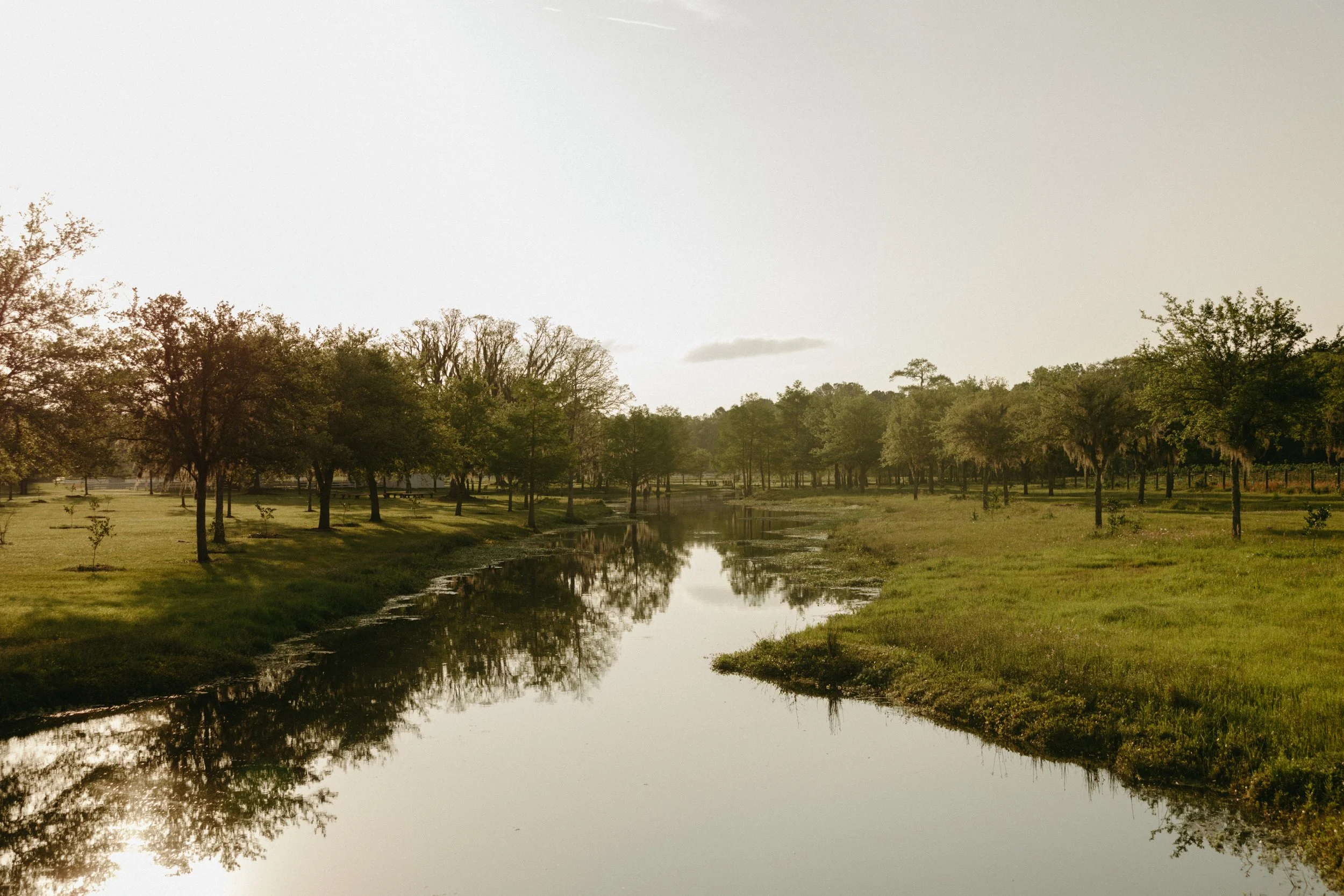
The Congaree & Penn farm has been working land for twenty years. There are real seasons here, real harvests, real decisions made about soil and water and what gets planted and what gets pulled. The farm has a table that feeds people, a kitchen that knows where everything came from, and a name that carries the weight of that history. When you steward one of these eleven homesteads, you are not buying into a fantasy. You are buying into an economy.
A Farm Within the Farm
Each homestead sits on ten acres of land adjacent to the mother farm. What you do with those acres is yours to decide: an orchard, rows of vegetables, bees, animals, a pond. But you are not doing it alone, and you are not starting from scratch.
Twenty years of know-how surrounds you. Shared infrastructure. A community of people who chose the same thing you chose. And a living agrarian system that your homestead can plug into directly. Surplus from your land can move through the farm's table and store. Your harvest isn't a hobby project; it is part of a real food system with a real name attached to it.
This is the distinction that matters most. The romance of starting your own farm, without the isolation or the risk that makes most people stop before they start.
Rhythm Over Schedule
What agrarian life actually offers, beyond the land itself, is a different relationship with time. The seasons set the agenda. What is ready to harvest determines what is on the table. The light in the morning tells you something. The quiet at dusk is not an absence of activity; it is the activity.
This is not a slower life in the way people mean when they say they want to slow down and then check their phone. It is a life organized around different signals. The farm teaches you to pay attention to things that are worth paying attention to.
The rhythm of planting and harvest replaces the rhythm of the calendar
The quality of what you grow becomes a measure of care, not productivity
The land asks something of you every day, and that asking is the point
Architecture That Belongs Here
We will write more about the homes themselves in the pieces that follow this one. But it is worth naming, here at the foundation, what we mean when we say architecture drawn from its own region.
In Florida, the vernacular is not ornamental. Deep porches, raised forms, cross-ventilation, screened transitions, standing-seam metal roofs oriented to the prevailing breeze: these are not aesthetic choices borrowed from somewhere else. They are the performance strategy that keeps a home cool, dry, and enduring in heat and humidity and storms. Beauty and function become the same decision, because they always were.
The homes at The Eleven are designed through Our Collective, a curated group of architects, builders, and interior designers who understand this. They design to the land. They use honest materials. They build structures that will not need to be explained or excused in twenty years, because they were right for this place from the beginning.
A home that belongs to its landscape does not need to announce itself. It simply endures.
Biophilic design is not a feature list here; it is the organizing principle. Rooms open to daylight and prevailing wind. The line between inside and out blurs by design. The home works hard, quietly, so the life on the land can feel effortless.
This is what we mean by purposeful simplicity: not spare, not minimal for the sake of minimalism, but edited with intention. The confidence to leave things out so the things that remain can matter.
Only Eleven
There is one more thing that matters, and it is the simplest.
Only eleven families will ever steward a piece of this farm. Not because we couldn't have made it more, but because more would have made it less. The density is the point. Ten acres each. Enough land to be genuinely on your own, genuinely responsible for something, genuinely connected to the seasons in a way that a half-acre lot in a gated community cannot provide.
The scarcity here is not manufactured. It is the natural result of doing this honestly.
What The Eleven offers is not a lifestyle product. It is a place. A specific, enduring, working piece of North Florida land with two decades of care behind it and a community of eleven families ahead of it. The farm-to-table dining, the lodging, the events, the daily rhythm of a real working farm: all of it is already in place, already alive, already earning the trust of the people who gather here.
You are not buying into something that is being built. You are joining something that already knows what it is.
The best reason to live here is the life here.
We are not building toward a vision of what this place might become. We are inviting eleven families to become part of what it already is. If that is the kind of ownership you have been looking for, we would like to show you the land.
Confidence doesn’t always arrive with a bold entrance. Sometimes, it builds quietly, step by step, as we show up for ourselves day after day. It grows when we choose to try, even when we’re unsure of the outcome. Every time you take action despite self-doubt, you reinforce the belief that you’re capable. Confidence isn’t about having all the answers — it’s about trusting that you can figure it out along the way.
The key to making things happen isn’t waiting for the perfect moment; it’s starting with what you have, where you are. Big goals can feel overwhelming when viewed all at once, but momentum builds through small, consistent action. Whether you’re working toward a personal milestone or a professional dream, progress comes from showing up — not perfectly, but persistently. Action creates clarity, and over time, those steps forward add up to something real.
You don’t need to be fearless to reach your goals, you just need to be willing. Willing to try, willing to learn, and willing to believe that you’re capable of more than you know. The road may not always be smooth, but growth rarely is. What matters most is that you keep going, keep learning, and keep believing in the version of yourself you’re becoming.